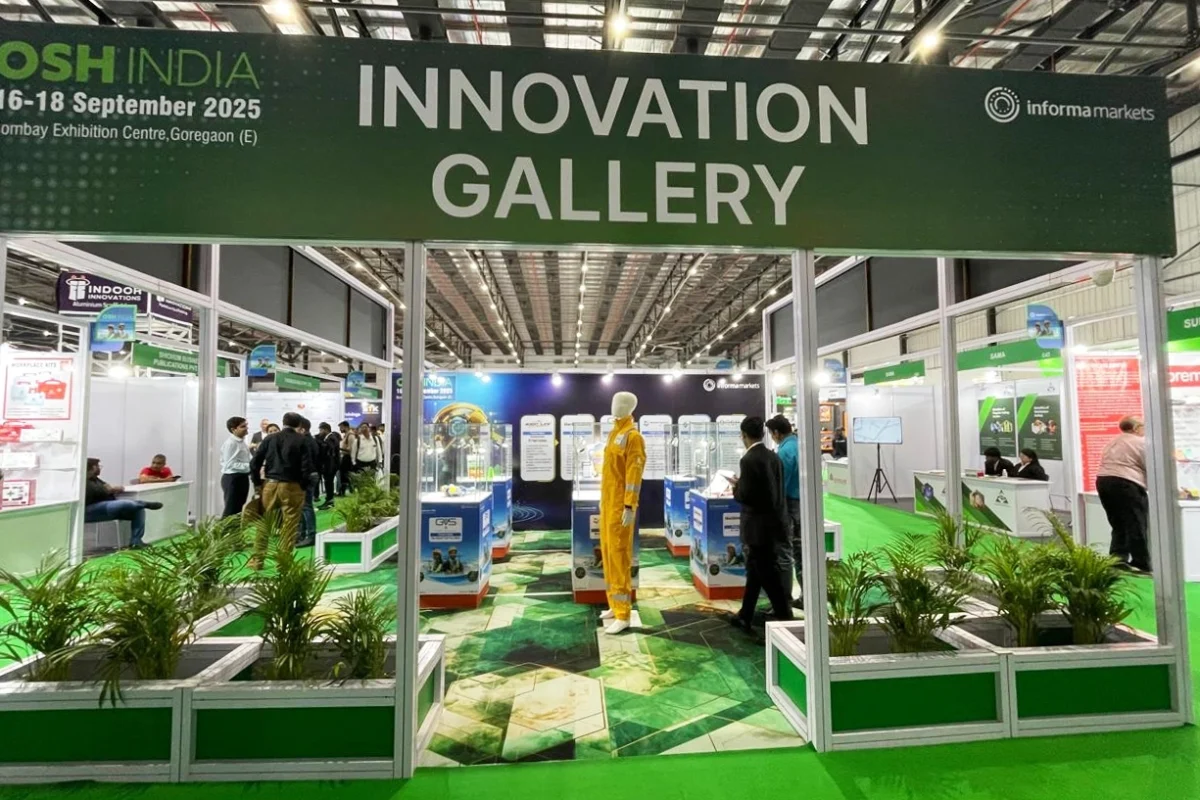
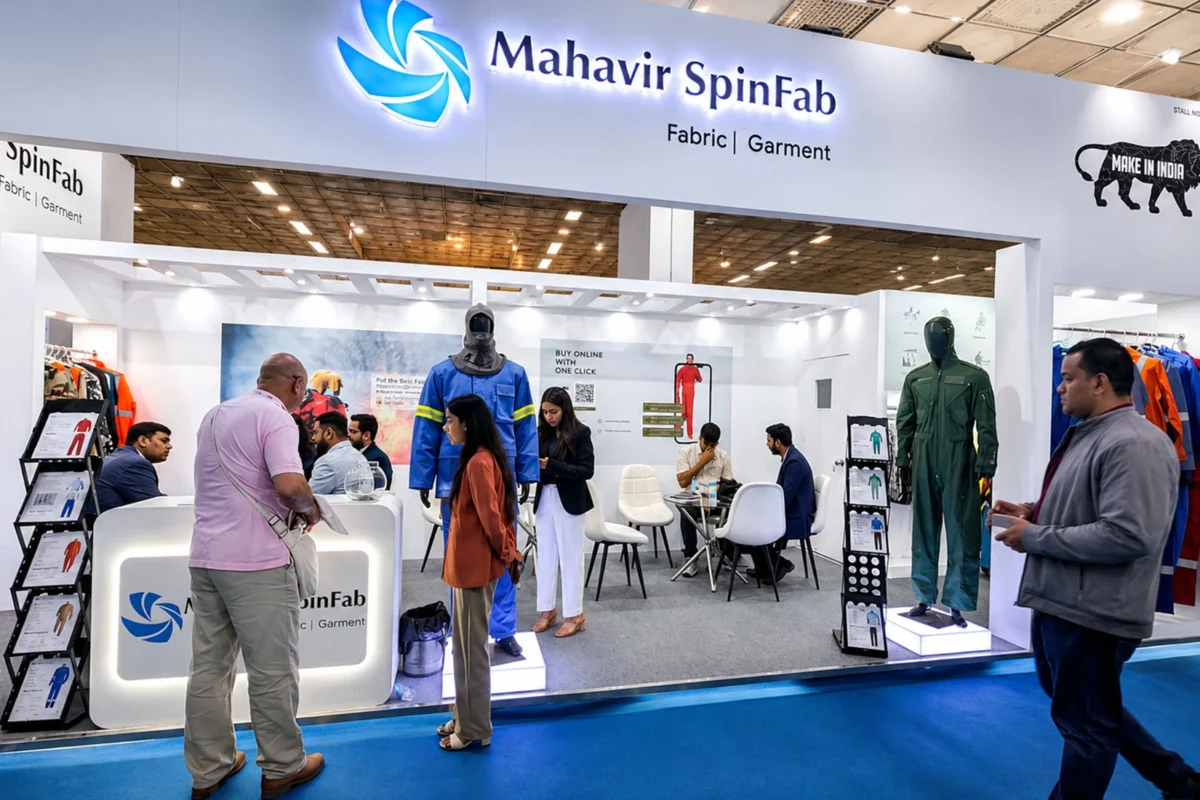
Mahavir SpinFab exhibition booth at Bharat Tex 2024 showcasing IFR, FR and arc flash protective clothing solutions

Mahavir SpinFab at Bharat Tex 2024: Advanced IFR, FR & Arc Flash Protective Solutions

Event: Bharat Tex 2024
Date: 14–17 February 2024
Venue: Bharat Mandapam, New Delhi
Booth No.: 12A-B4

Mahavir SpinFab proudly participated in Bharat Tex 2024, one of India’s leading textile exhibitions, where we showcased our advanced range of Inherently Flame Resistant (IFR) fabrics, Flame Resistant (FR) garments, and Arc Flash protective clothing designed for critical industrial environments.

The exhibition provided an excellent platform to connect with global buyers, PPE distributors, industrial safety professionals, procurement teams, and industry leaders looking for reliable protective textile and workwear solutions.

Strengthening Industrial Safety Through Innovation

At our booth, visitors experienced a comprehensive range of protective solutions engineered with a strong focus on safety, durability, comfort, and compliance. Our products are designed to support workers operating in high-risk environments where protection against flame, heat, electrical arc, and industrial hazards is essential.

Featured Products at Bharat Tex 2024

Inherently Flame Resistant (IFR) Fabrics

Our IFR fabrics are developed to provide permanent flame-resistant performance that remains effective throughout the garment’s lifecycle. These fabrics are suitable for industries where long-term protection, comfort, and reliability are critical.

  • Permanent flame resistance
  • Arc flash protection
  • High thermal performance
  • Lightweight comfort
  • Long-lasting durability

Flame Resistant (FR) Garments

Mahavir SpinFab also displayed a strong range of FR protective garments designed for industrial workers, safety teams, and organizations operating in demanding work environments.

  • IFR Coveralls
  • Arc Flash Suits
  • FR Shirts & Trousers
  • FR Jackets
  • High-Visibility FR Apparel
  • Customized Industrial Workwear

Showcasing Our Brands

uniformer – Professional Uniform Solutions

uniformer offers customized uniform solutions for multiple industries with a focus on practical design, professional appearance, and bulk production capability. The brand serves businesses looking for reliable uniforms with branding, embroidery, and logo application support.

  • Hospitality uniforms
  • Healthcare uniforms
  • Corporate office uniforms
  • Educational institution uniforms
  • Manufacturing facility uniforms
  • Customized logo branding and embroidery

Nomadic – Industrial Safety & PPE Workwear

Nomadic represents our specialized protective workwear and PPE garment range built for industrial safety applications. The brand focuses on high-performance protective apparel for critical sectors where compliance, safety, and comfort are essential.

  • IFR Coveralls
  • Arc Flash Clothing
  • High-Visibility Safety Wear
  • Oil & Gas Workwear
  • Mining & Construction PPE
  • Customized Industrial Garments

Industries We Serve

Mahavir SpinFab provides protective clothing and textile solutions for a wide range of industries where worker safety and garment performance are top priorities.

  • Oil & Gas
  • Electrical Utilities
  • Power Generation
  • Petrochemicals
  • Mining
  • Metal Processing
  • Defence
  • Industrial Manufacturing

Driving Sustainability with IFR Fabric Recycling

As part of our commitment to sustainable manufacturing, Mahavir SpinFab has introduced an IFR Fabric Recycling Initiative focused on recovering and repurposing post-industrial flame-resistant fabric waste.

This initiative supports responsible manufacturing practices and helps reduce textile waste while improving the utilization of high-performance IFR fibers.

Project Objectives

  • Reduce textile waste
  • Promote circular manufacturing
  • Improve utilization of IFR fibers
  • Lower environmental impact
  • Support sustainable PPE sourcing

Benefits for Customers

  • Supports ESG goals
  • Encourages responsible supply chain sourcing
  • Reduces environmental footprint
  • Supports sustainable procurement initiatives
  • Aligns with global sustainability expectations
Looking ahead

Bharat Tex 2024 reinforced Mahavir SpinFab’s position as a trusted manufacturer of advanced protective textiles, IFR fabrics, FR garments, Arc Flash clothing, and industrial workwear solutions.

As we continue to innovate and expand our capabilities, we remain committed to delivering protective textile solutions that enhance worker safety, support industrial performance, and contribute to sustainable manufacturing practices.

Partner with Mahavir SpinFab for high-performance IFR fabrics, FR garments, Arc Flash protection, industrial uniforms, and sustainable protective clothing solutions.

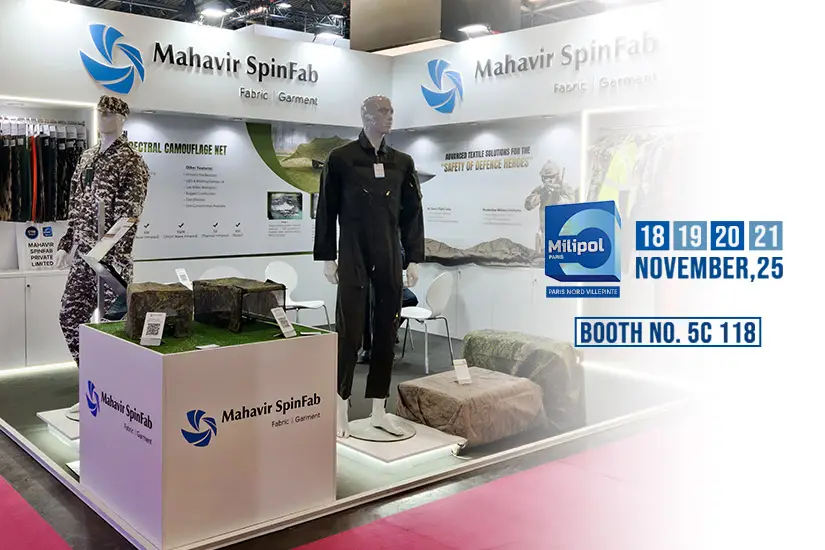
Mahavir Spinfab booth 5C 118 at Milipol Paris 2025 showcasing next-gen defence textiles, combat suits, and camouflage nets.

Mahavir Spinfab at Milipol Paris 2025: Next-Gen Defence Textiles

Mahavir Spinfab Live at Milipol Paris 2025

📍 Booth: 5C 118
📅 18–21 November 2025

Mahavir Spinfab is proud to announce its participation in Milipol Paris 2025, the world’s leading event for homeland security and defence innovations. This year, we are unveiling a powerful lineup of next-generation defence textile technologies designed to meet the evolving needs of modern armed forces.

Unveiling Advanced Defence Textile Solutions

At our booth, visitors will experience a comprehensive range of cutting-edge protective solutions, engineered with precision, durability, and mission performance at their core.

🔹 Combat Suits with IFR & NIR Capabilities

Our combat suits are built to deliver superior protection without compromising mobility. Featuring Inherent Flame Retardant (IFR) performance and effective Near-Infrared (NIR) signature management, these suits ensure enhanced survivability across diverse operational environments.

🔹 Advanced Flight Suits

Designed for maximum comfort and safety, our flight suits incorporate high-strength fabrics, thermal stability, and ergonomic tailoring—supporting aircrew in demanding, fast-paced mission profiles.

🔹 Multi-Spectral Camouflage Nets (MSCN)

Our MSCN systems offer advanced concealment across multiple spectral bands, including visible, NIR, SWIR, and thermal. Whether for mobile units or fixed installations, these nets provide reliable protection against modern surveillance and targeting systems.

Why Visit Mahavir Spinfab at Milipol 2025?

  • First-hand experience of breakthrough textile engineering

  • Live product demos and technical insights

  • Direct discussions with our R&D and defence solutions specialists

  • Opportunities for collaboration with a global defence ecosystem

We warmly invite industry partners, procurement agencies, and defence leaders to visit us and discover what sets Mahavir Spinfab apart in the world of protection textiles.

👉 Schedule a meeting and explore our full product range:
https://mahavirspinfab.com/defence-protective-solutions-milipol-paris/

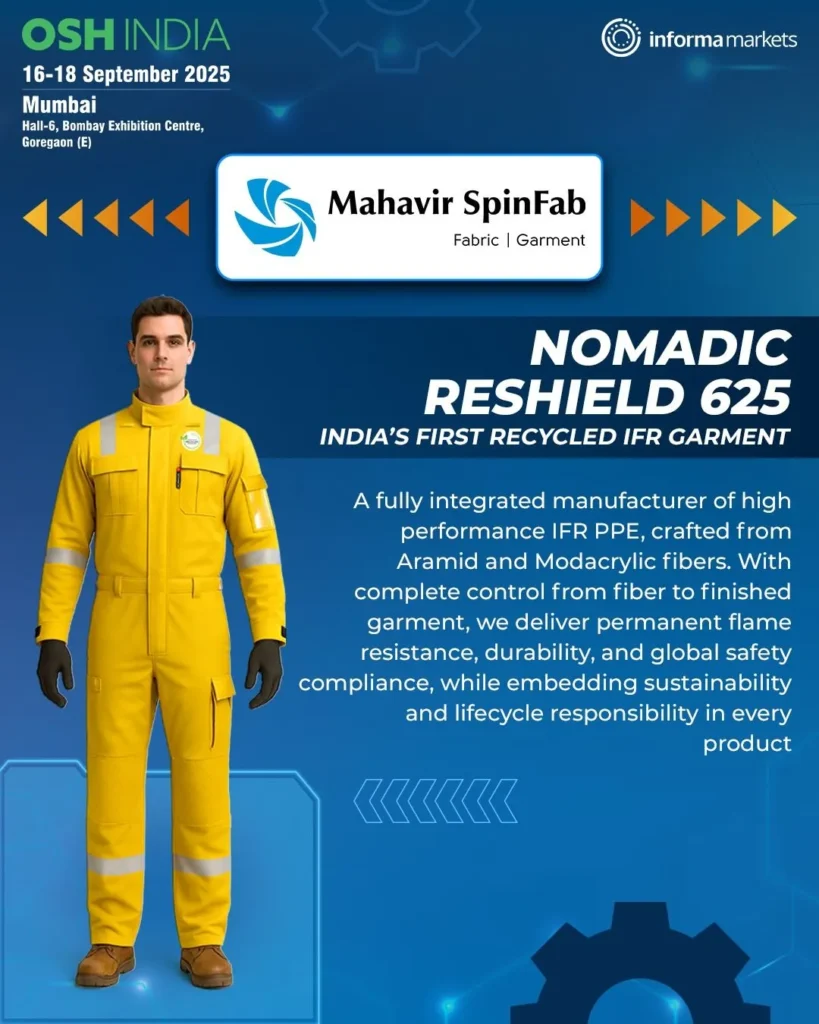
Mahavir Spin Fab unveils India’s first recycled IFR garment at OSH India 2025

India’s First Recycled IFR Garment

India’s First Recycled IFR Garment: The Future of Sustainable Protective Clothing

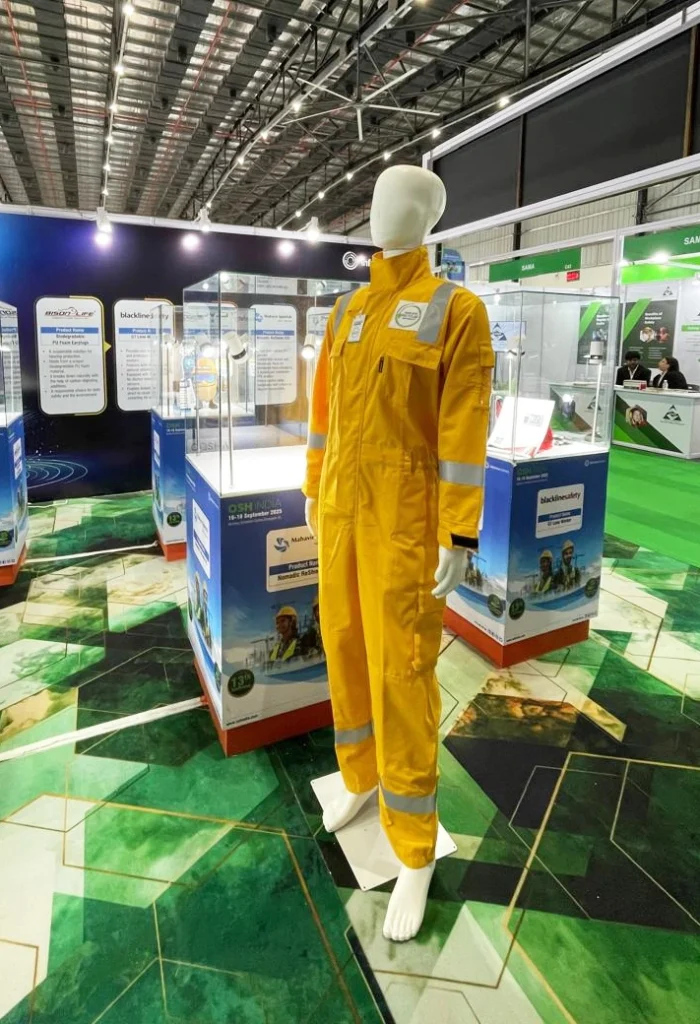
India’s First Recycled IFR Garment showcased at OSH India 2025 by Mahavir SpinFab

Big news from OSH India 2025

Mahavir Spin Fab has made history by unveiling India’s first recycled Inherent Flame-Resistant (IFR) garment — a pioneering step in aramid recycling. This game-changing innovation was recognized as the 3rd Most Innovative Product at OSH India, proving that sustainability and safety can go hand in hand.

Why recycle textiles in the first place?

    • Market Growth – The global textile market was valued at $610.91 billion in 2023 and is projected to reach $755.38 billion by 2027, growing at a compound annual growth rate of 5.5%, reflecting accelerating global demand and production.
    • Waste Generation – The textile industry is responsible for 20% of total global waste, with annual textile waste expected to grow by 60% per year from 2015 to 2030, reaching 148 million tons by 2030. Currently, 92 million tons of textile waste are generated each year, of which 73% is incinerated or landfilled, 25% is reused or recycled, and less than 1% is recycled back into clothing, resulting in a $100 billion annual loss in raw materials.
  • Carbon Emissions – The industry emits 1.2 billion tons of CO₂-equivalent greenhouse gases annually, exceeding emissions from all international transport. By 2030, emissions are projected to rise by over 60%, reaching 2.8–2.9 billion tons per year, with two-thirds of these emissions linked to synthetic fiber processing. The fashion sector alone contributes over 10% of global carbon emissions, and if current demand continues, it could account for approximately 25% of global emissions by 2050.

What happens to most end-of-life IFR garments today?

Here lies the hidden graveyard of aramid garments:
  • Less than 1% of IFR clothing (Kevlar, Nomex, Conex) is ever recycled.
  • The majority ends up in landfills or is incinerated.
  • > Burning aramids releases toxic gases like hydrogen cyanide (HCN), carbon monoxide (CO), and nitrogen oxides (NOₓ).
  • Many garments are classified as hazardous waste because they’re contaminated with oils, and chemicals.
The irony? These garments are designed to be indestructible — a lifesaver for workers, but a nightmare for the planet.

Why is recycling IFR garments such a challenge?

FR workwear recycling isn’t as straightforward as recycling cotton or polyester. Key challenges include:
  • Non-biodegradability of aramids → they persist for centuries.
  • Hazardous emissions if burned.
  • Mechanical strength of aramids makes shredding extremely difficult.
  • Chemical finishes & blends complicate separation and recycling.

What does Mahavir Spin Fab’s innovation mean for the industry?

By successfully creating recycled IFR garments, Mahavir Spin Fab has:
  • Proven that a circular economy in textiles is possible even for complex materials like aramids.
  • Opened the door for sustainable protective clothing that reduces dependence on virgin fibers.
  • Helped cut carbon emissions and prevent landfill waste.
  • Positioned India as a leader in flame-resistant clothing waste management.

How does recycling benefit workers and the environment?

  • Lower Carbon Footprint – Each recycled garment saves significant CO₂ emissions.
  • Less Landfill Waste – Prevents hazardous fibers from piling up underground.
  • Safer Workwear Choices – Recycled IFR garments can still meet safety standards.
  • Consumer Trust – Certifications like GRS (Global Recycled Standard) assure eco-conscious production.

What’s next for protective clothing sustainability?

The future lies in:
  • Scaling recycling infrastructure for aramids & IFR garments.
  • Collaborations between manufacturers, recyclers, and end-users.
  • Smarter collection systems for post-consumer waste (laundries, industries, government).
  • Innovation in blends & finishes that are easier to recycle.
Mahavir Spin Fab’s milestone shows that sustainable workwear isn’t a dream — it’s already here.

The Future is Circular

For decades, the end-of-life plan for IFR garments was a graveyard of landfills and toxic incineration. With this breakthrough, India’s first recycled IFR garment proves a new path is possible — one where safety, sustainability, and circularity come together.The future of protective clothing is not just flame-resistant. It’s planet-resistant.

Be Part of the Recycling Revolution

Every step towards recycling helps reduce textile waste and protect our environment.
Join us in creating a greener, safer, and sustainable future.

NSC 2025: IFR & FR Protective Fabrics | Mahavir Spinfab

We Are Live at NSC 2025! 🚀

We’re live at the National Safety Council Exhibition from 15th to 17th September 2025, at Booth No. #1533! Mahavir Spinfab is proud to showcase its certified protective fabrics and garments, designed for Oil & Gas, Power Generation, Smelting, and Defence industries.Discover how we are driving innovation in protective wear while staying true to our core vision of safety and sustainability.

Specialists in IFR & FR Garments

Our high-performance IFR and FR fabrics, crafted from Aramid and Modacrylic fibers, deliver permanent flame resistance at the fiber level. Built for industries where thermal, arc flash, and fire hazards are real, our garments ensure long-term protection, durability, and wearer confidence.

One Step Closer to Saving the World – Recycling for a Safer Future

We are recycling old and used IFR garments into new high-performance workwear. This circular approach:
  • Extends fiber life
  • Reduces waste
  • Cuts carbon emissions
  • Supports global sustainability goals
All this without compromising flame-resistant protection.

From Fiber to Finish – Our Capabilities

With end-to-end in-house manufacturing—spinning, weaving, dyeing, finishing, coating, lamination, and stitching—Mahavir delivers robust solutions backed by global certifications like OEKO-TEX®, ANSI, GRS, Sedex, UL, and CE.👉 Visit us at Booth #1533, NSC 2025, and experience how Mahavir Spinfab is creating a cleaner, safer, and more sustainable future in protective wear.
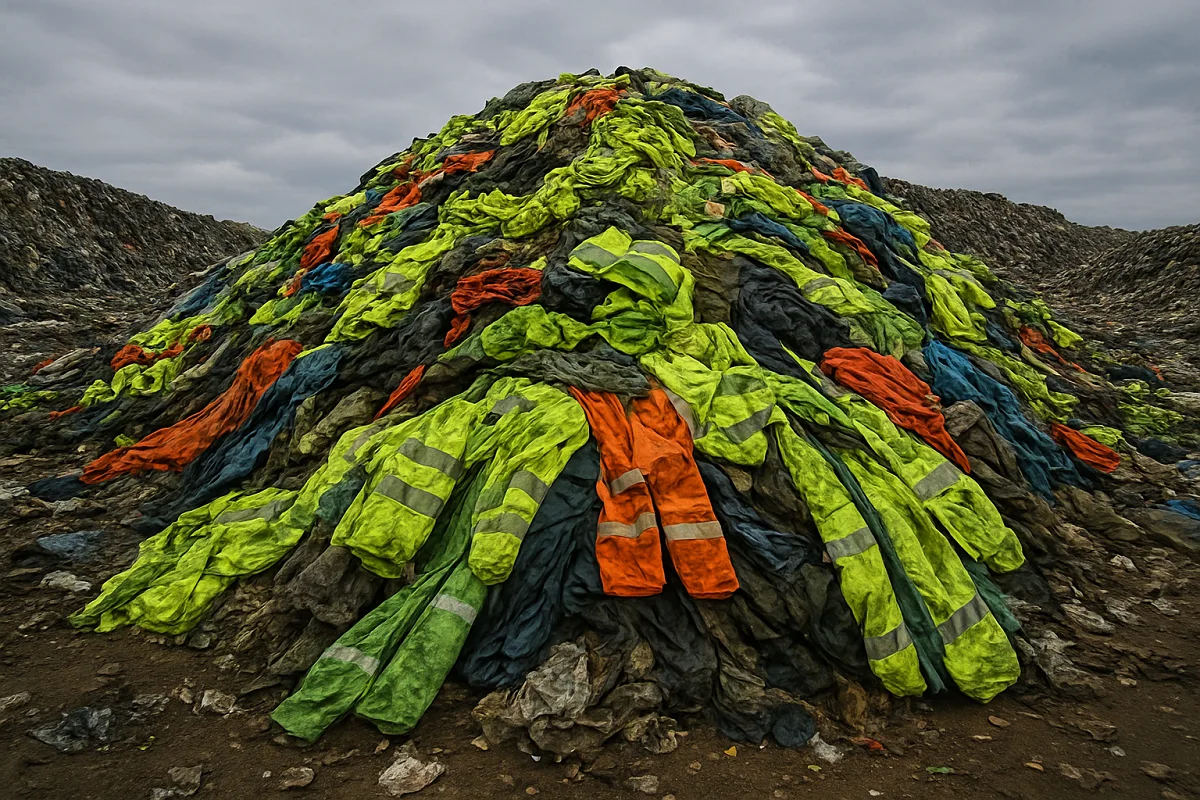
Discarded flame-resistant reflective coveralls showing need for textile recycling – Mahavir Spinfab

Textile Waste: A Growing Crisis and the Need for Recycling

Why is textile waste a problem?

The textile industry is one of the largest polluters in the world. Every year, around 92 million tonnes of textile waste is generated globally — equal to a garbage truck of clothes being dumped every second. If no action is taken, this number will rise to 134 million tonnes by 2030 and more than 200 million tonnes by 2050.Most of this waste ends up in landfills or is incinerated, releasing harmful greenhouse gases and toxic chemicals. Beyond pollution, it also means wasting resources such as water, energy, cotton, polyester, and dyes used in production.

What are the different types of textile waste?

Textile waste comes in several forms:
  • Pre-consumer waste: Fabric scraps, yarn waste, and rejects from textile mills.
  • Post-consumer waste: Discarded clothes, uniforms, bedsheets, towels, and other used textiles.
  • Post-industrial waste: Leftovers from garment manufacturing, finishing, and distribution.

Where does textile waste come from?

The sources of textile waste include:
  • Fast fashion: Cheap, short-lived garments that consumers discard quickly.
  • Factories: Cutting scraps, rejected fabric, and yarn waste.
  • Consumers: Old clothes and home textiles thrown away after limited use.
Globally, nearly 87% of all textiles are sent to landfills or incinerated after their first use.

What is textile waste management?

Textile waste management refers to how textile waste is handled to minimize environmental impact. Common practices include:
  • Reuse: Donation, resale, or repairing garments.
  • Recycling: Mechanical shredding into fibers or chemical recycling into raw materials.
  • Circular economy: Policies like Extended Producer Responsibility (EPR), where brands must collect and recycle their own waste.

Is India facing a textile waste crisis?

Yes. India generates about 7.8 million tonnes of textile waste annually, making it the third-largest generator globally. While India has a strong informal recycling sector (ragpickers, collectors, sorters, and resellers), a large portion of textile waste still ends up in landfills.With the growing popularity of fast fashion in India, the country risks facing a serious textile waste crisis unless formal recycling systems and strict policies are adopted.

How much textile waste is generated in India and the world?

  • Global: 92 million tonnes annually → projected to reach 134 million tonnes by 2030.
  • India: Around 7.8 million tonnes annually (about 8% of global waste).
Unfortunately, around 73% of post-consumer textile waste goes to landfills or is burned. Only 12% is downcycled into lower-value products, 2% is reused in other industries, and less than 1% is truly closed-loop recycled into new clothes.

Can textile waste be recycled?

Yes, textile waste can be recycled in several ways:
  • Reuse & upcycling: Donating or creatively repurposing old garments.
  • Mechanical recycling: Shredding textiles into fibers and respinning them into yarn.
  • Chemical recycling: Breaking down fabrics like polyester or blends into raw materials to make new fibers.

Can textile waste be stored with dry waste?

Technically, textiles are classified as dry waste. But for better recycling, it’s best to collect them separately. Cotton, polyester, wool, and blends each need different recycling methods. Mixing them reduces the quality of recycled fibers and makes recycling less efficient.

Take Action for a Sustainable Future

Textile waste is not just an environmental problem, it’s an opportunity to build a circular economy and promote sustainable fashion. At Mahavir Spinfab, we are committed to eco-friendly textile solutions that reduce waste and protect our planet.

Take Action Against Textile Waste

Every step towards recycling helps reduce textile waste and protect our environment. Join us in creating a greener, safer, and sustainable future.